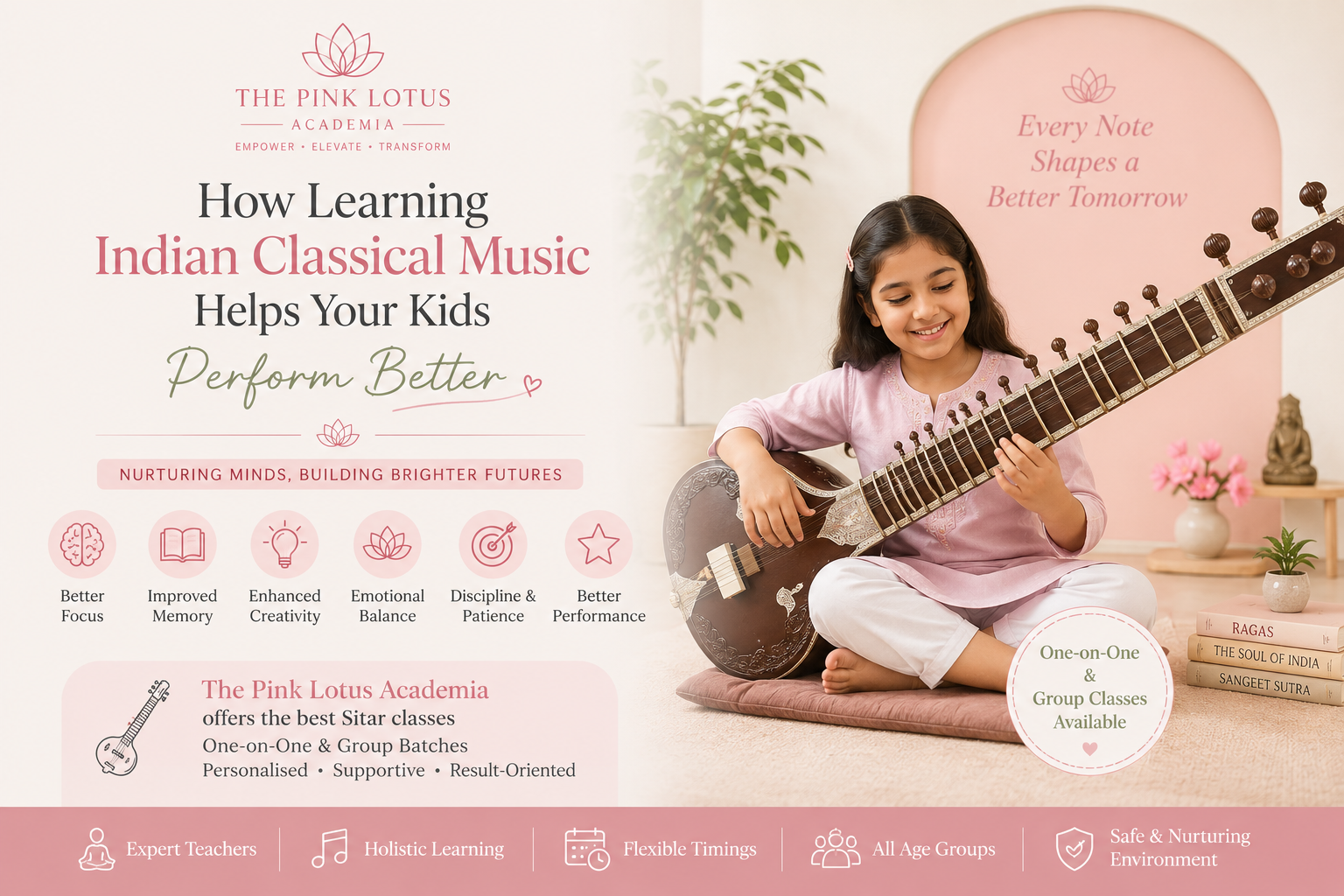
How Learning Music Specially Indian Classical Music Helps Your Kids Perform Better
In today’s fast-paced digital world, children are constantly surrounded by screens, distractions, academic pressure, and overstimulation. Parents everywhere are searching for meaningful activities that not only help their children grow creatively but also support mental focus, emotional balance, and long-term development. One of the most powerful and timeless solutions is music education, especially Indian Classical Music.
Learning Indian Classical Music is far more than simply learning notes or songs. It trains the brain, sharpens listening abilities, develops discipline, and nurtures emotional intelligence. Many parents are now realizing that children who engage with music from an early age often perform better academically, socially, and emotionally.
At The Pink Lotus Academia, children are introduced to Indian Classical Music through structured yet enjoyable learning methods. The academy is known for offering some of the best Sitar classes in New Delhi with both one-on-one learning and group batches. The teaching approach is deeply personalized, helping children learn comfortably at their own pace.
Unlike highly competitive learning environments that create stress, The Pink Lotus Academia focuses on nurturing curiosity and confidence. Some children learn best individually with personal attention, while others thrive in group settings where collaborative learning keeps them motivated. The academy offers both options thoughtfully.
Parents often notice major positive changes in their children after consistent music practice:
- Better concentration
- Increased patience
- Improved listening skills
- Greater emotional balance
- More confidence during public interaction
These changes don’t happen overnight, but music slowly reshapes how children think, feel, and express themselves.
Why Music Education Matters in Childhood
Childhood is the foundation stage for cognitive and emotional development. Activities introduced during these years often influence personality, discipline, and learning abilities for life.
Music education stimulates multiple areas of the brain simultaneously. When children practice music, they engage:
- Listening skills
- Memory retention
- Motor coordination
- Pattern recognition
- Emotional processing
This combination makes music one of the most holistic developmental tools available.
Unlike passive entertainment, learning music requires active participation. Children must observe carefully, repeat patterns, recognize tonal differences, and develop coordination between mind and body.
Studies in educational psychology often suggest that music training can positively influence:
| Skill | Benefit |
|---|---|
| Memory | Better retention abilities |
| Focus | Improved concentration span |
| Discipline | Structured daily habits |
| Creativity | Flexible thinking |
| Communication | Better expression |
Indian Classical Music particularly emphasizes deep listening and concentration, which naturally strengthens mental discipline.
At The Pink Lotus Academia, teachers understand that every child learns differently. Some students are naturally expressive, while others may initially be shy or hesitant. The personalized teaching style ensures that children feel encouraged instead of pressured.
That supportive environment makes a huge difference in how children respond to learning.
Understanding Indian Classical Music for Kids
What Makes Indian Classical Music Unique
Indian Classical Music is one of the oldest musical traditions in the world. Unlike fast-paced modern entertainment music, it focuses deeply on:
- Listening
- Emotional nuance
- Improvisation
- Discipline
- Raga-based expression
This creates a calming and intellectually stimulating experience for children.
The beauty of Indian Classical Music lies in its ability to train the ear naturally. Children gradually learn:
- Pitch recognition
- Rhythm understanding
- Tonal sensitivity
- Patience during practice
These skills carry over into everyday life and academic learning.
Indian Classical Music also develops a child’s relationship with silence and attention. In a noisy digital world filled with constant stimulation, this becomes increasingly valuable.
The Role of Discipline and Listening
Children today are often encouraged to multitask constantly. Music practice, however, teaches the opposite.
It teaches:
- Slowing down
- Listening carefully
- Repeating patiently
- Observing deeply
This discipline is incredibly powerful.
When children learn instruments like the Sitar, they develop consistency through daily practice. They begin understanding that progress happens gradually through repetition and dedication.
That lesson alone becomes useful throughout life.
Cognitive Benefits of Learning Indian Classical Music
Improved Memory and Concentration
One of the most noticeable benefits parents observe is improved concentration.
Learning Indian Classical Music requires children to:
- Remember note sequences
- Identify rhythmic cycles
- Focus during repetition
- Listen carefully to tonal variations
This strengthens neural pathways connected to memory and attention.
Children who struggle with focus often benefit significantly from structured musical learning because music creates engaging mental stimulation without overwhelming pressure.
Better Academic Performance
Music and academics are more connected than many people realize.
Music practice improves:
- Pattern recognition
- Sequential thinking
- Auditory processing
- Mathematical understanding
Rhythm itself contains mathematical structure. Children unconsciously develop counting abilities and timing awareness through music.
Parents often report that children become:
- More organized
- More attentive during studies
- Better at problem-solving
- More patient with learning challenges
These improvements occur because music strengthens cognitive flexibility.
Enhanced Creativity and Problem Solving
Indian Classical Music encourages creativity through improvisation and emotional interpretation.
Children learn:
- How to think independently
- How to explore ideas creatively
- How to express emotions artistically
Creative thinking becomes increasingly important in modern education and future careers.
Music teaches children not just how to follow instructions, but also how to interpret and innovate within structure.
Emotional Benefits of Music Education
Building Confidence
Confidence develops gradually through achievement and self-expression.
When children learn music:
- They perform in front of others
- They overcome mistakes
- They improve steadily over time
Each small success builds self-belief.
At The Pink Lotus Academia, children are encouraged gently rather than criticized harshly. This supportive teaching style helps shy students become more expressive and comfortable socially.
Emotional Expression and Stability
Children don’t always know how to communicate emotions verbally.
Music provides:
- Emotional release
- Creative expression
- Mental calmness
- Stress reduction
Indian Classical Music especially has a meditative and emotionally grounding quality that helps children regulate emotions naturally.
Parents often notice that children become calmer and emotionally balanced after regular music practice.
How Sitar Training Shapes Personality
Patience and Focus Through Practice
The Sitar is not an instrument learned overnight.
It requires:
- Attention to detail
- Finger coordination
- Listening sensitivity
- Consistent effort
This naturally teaches patience.
In a world of instant gratification, learning the Sitar reminds children that meaningful progress takes time and dedication.
That mindset becomes valuable in every area of life.
Respect for Tradition and Culture
Learning Indian Classical Music also connects children with Indian heritage and artistic traditions.
Children begin appreciating:
- Cultural depth
- Traditional knowledge
- Musical history
- Artistic discipline
This creates both cultural awareness and emotional grounding.
Why Parents Are Choosing Sitar Classes for Children
Many parents now prefer Sitar training because it combines:
- Intellectual growth
- Emotional balance
- Creative expression
- Cultural learning
Unlike highly commercialized music formats, the Sitar encourages mindful learning and deep listening.
At The Pink Lotus Academia, children can choose between:
- Personalized one-on-one classes
- Interactive group batches
This flexibility allows parents to select the learning format best suited for their child’s personality.
The Pink Lotus Academia – The Best Place to Learn Sitar
One-on-One Sitar Classes
Some children learn best through personalized attention.
The one-on-one classes at The Pink Lotus Academia help:
- Build confidence faster
- Address individual challenges
- Customize lesson pacing
- Strengthen teacher-student connection
This format is especially useful for beginners.
Group Batch Learning
Group classes create:
- Social interaction
- Collaborative learning
- Motivation through peer support
Children often enjoy learning alongside friends while still receiving proper guidance.
Personalized Teaching Approach
The academy focuses heavily on student comfort and learning style.
Teachers ensure that:
- Children don’t feel pressured
- Lessons remain engaging
- Learning stays balanced and enjoyable
That nurturing approach helps children develop genuine love for music.
Online and Offline Learning Options
Modern families often need flexibility.
The Pink Lotus Academia offers:
- Offline classes in New Delhi
- Online learning options
- Flexible scheduling
This allows children from different cities and countries to access quality Indian Classical Music education.
How Music Helps Children in the Digital Age
Children today face:
- Screen addiction
- Reduced attention spans
- Constant distractions
Music provides an important balance.
Indian Classical Music encourages:
- Mindful listening
- Deep concentration
- Emotional awareness
- Creative thinking
These skills are becoming increasingly rare yet incredibly valuable.
Learning music doesn’t just create musicians.
It creates more balanced human beings.
For more information about music education and child development, parents can also explore UNESCO Arts Education Resources.
Frequently Asked Questions
At what age can children start learning Sitar?
Children can usually begin basic Sitar learning around 6–7 years old, depending on focus and interest levels.
Does learning Indian Classical Music improve academic performance?
Many parents and educators observe improvements in concentration, memory, discipline, and listening skills.
Are one-on-one Sitar classes better for beginners?
Personalized classes can help beginners progress comfortably with focused guidance.
Can shy children benefit from music education?
Absolutely. Music often helps children become more expressive and confident socially.
How often should children practice music?
Consistency matters more than duration. Even 20–30 minutes of regular practice can be beneficial.
Does The Pink Lotus Academia offer online Sitar classes?
Yes. The academy offers both online and offline learning options.
Conclusion
Music has the power to shape a child’s mind, emotions, confidence, and personality in extraordinary ways. Indian Classical Music, with its deep focus on listening, discipline, and emotional awareness, offers benefits that extend far beyond musical ability.
Children who learn music often become:
- More focused
- More patient
- More emotionally balanced
- More creative
- More confident
At The Pink Lotus Academia, children receive thoughtful and personalized Sitar education through both one-on-one classes and group batches. The academy creates a nurturing environment where learning feels inspiring instead of stressful.
For parents searching for meaningful activities that truly support their child’s growth, Indian Classical Music may become one of the most valuable gifts they can offer.
Post-Article Message: Thank you for reading this comprehensive guide on how learning Indian Classical Music helps kids perform better. We hope this article helps parents discover the long-term emotional, intellectual, and creative benefits of music education through The Pink Lotus Academia.
Instagram: @thepinklotusacademia
Facebook: @thepinklotusacademia
Faculty:Kaavita Das
Enquire Now: Click Here
Yoga Apparells: https://amzn.to/47rLhVl
Learn more: The Pink Lotus Academi