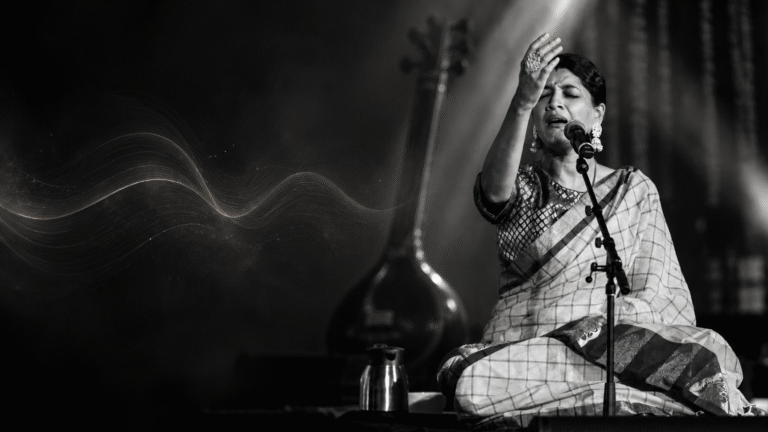
What happens when a classical vocalist is told to stop singing? For Carnatic musician Dr. Sowmya Gurucharan, two years of silence became an unexpected journey into the very soul of music.
Imagine spending your entire life learning to sing.
Imagine years of rigorous training, countless hours of riyaaz, a childhood surrounded by music, and a voice that has become inseparable from your identity.
Now imagine being told that you must stop using that voice.
For most professional singers, the thought alone would be terrifying.
But for Dr. Sowmya Gurucharan, an accomplished Carnatic classical vocalist, researcher and performer associated with the Anirudh Varma Collective, this became a reality in 2018.
What followed was not simply a period of recovery.
It was an extraordinary musical transformation.
In an intimate conversation with The Pink Lotus Academia, Sowmya shared how a vocal-cord injury forced her to reconsider everything she thought she knew about singing, listening and understanding music.
And how, during almost two years without conventional singing, she discovered something that decades of musical training had not fully revealed.
The voice may produce music, but the mind must first learn to hear it.
A Voice That Had Been Singing Since Childhood
Sowmya Gurucharan’s relationship with music began long before she understood what it meant to be a professional musician.
Born into a family deeply rooted in the Bhajana Sampradaya tradition, she grew up surrounded by devotional and classical music.
Her paternal great-grandfather, Poundarigapuram Ramakoti Veeraraghava Iyengar, was a respected Kathakalakshepam exponent.
Her earliest musical lessons came from her grandmother, Smt. Vijayalakshmi.
By the age of approximately two-and-a-half or three, Sowmya was already singing.
As she grew older, her mother recognised her musical potential and encouraged her to pursue more structured training.
She subsequently spent approximately thirteen years learning under Sangita Vidwan S. Vishwanathan.
Her musical education continued under Dr. Ravi Kumar Malladi and Prof. Dr. P.B. Kanna Kumar.
Music was never simply an extracurricular pursuit.
It was a way of life.
Over time, Sowmya established herself as a Carnatic classical vocalist, earned a PhD in Music from the University of Delhi, and developed a career encompassing performance, teaching and research.
But in 2018, that musical journey encountered an unexpected challenge.
2018: The Year Everything Changed
During our conversation, Sowmya recalled developing nodules on her vocal cords.
For a professional singer, vocal-cord nodules can be particularly concerning because they may interfere with the very mechanism through which a singer creates sound.
She consulted medical professionals, and surgery was among the options discussed.
Sowmya ultimately decided against surgery and pursued a non-surgical course of care under medical guidance.
But that decision came with a significant personal challenge.
She would have to step away from conventional vocal practice.
Not for a few days.
Not for a few weeks.
Her account describes a period extending to almost two years.
For someone who had been singing since early childhood, this was an enormous change.
And yet, Sowmya’s recollection of those years contains surprisingly little bitterness.
Instead, she speaks about them with gratitude.
“Two Years of Silence From Performance”
During the interview, Sowmya described those years as a period of musical penance.
Unable to engage in her familiar vocal practice, she began exploring another way of experiencing music.
She started singing in her mind.
At first, the idea seemed almost impossible.
How could a singer practise without producing a sound?
How could one develop musical ideas without physically singing them?
How could the mind substitute for something as instinctive as the human voice?
Sowmya remembers initially laughing at the suggestion that she should sing mentally.
After all, even humming is such a natural reflex for musicians that consciously avoiding it can be difficult.
But gradually, the unfamiliar exercise became a new form of musical discipline.
She began imagining phrases, listening internally and concentrating on the music without physically producing it.
The process changed her understanding of what practice could mean.
Rather than abandoning music, she had begun exploring it from within.
The Extraordinary Power of Mental Riyaaz
For most students of Indian classical music, riyaaz is associated with audible repetition.
Singing swaras.
Practising alankars.
Developing breath control.
Exploring ragas.
Repeating compositions until their structures become instinctive.
These remain essential aspects of conventional musical training.
But Sowmya’s experience introduced another dimension: mental riyaaz.
During those two years, she began concentrating intensely on the music she could hear internally.
She became increasingly conscious of shruti, melodic relationships and the subtle qualities of musical sound.
She discovered that the mind could continue engaging with musical structures even when her voice was resting.
In our conversation, she reflected on the extraordinary capabilities of the human mind and how little of its potential we consciously explore.
What had initially appeared to be an obstacle gradually became a new method of musical inquiry.
She was no longer concerned only with whether she could execute a phrase.
She wanted to understand why a phrase mattered.
Learning to Listen All Over Again
Perhaps the most fascinating part of Sowmya’s story is what she chose to do with the time she could no longer spend singing.
She listened.
Not casually.
Not merely for enjoyment.
She listened with the concentration of someone attempting to understand the deepest foundations of musical expression.
She revisited the music of great classical masters, including artists whose performances had continued to inspire generations long after their lifetimes.
And she began asking herself questions.
Why does the music of certain masters remain so powerful?
What makes a musical phrase feel soulful?
Why can a performance recorded decades earlier continue to move listeners today?
What is it that separates technical brilliance from artistic profundity?
These questions gradually changed the direction of her musical thinking.
Instead of simply learning how great musicians performed, she began exploring what made their music great.
That distinction became central to her development.
The Tanpura, Shruti and a Moment of Musical Oneness
One of the most profound moments in our conversation came when Sowmya spoke about the tanpura.
For an Indian classical musician, the tanpura is far more than an accompanying instrument.
Its continuous drone provides the tonal reference around which a raga unfolds.
It is the musical ground upon which the singer builds an entire universe of expression.
During her period of mental practice, Sowmya began developing an increasingly intimate relationship with this sound.
Her aspiration was not simply to sing accurately against the tanpura.
It was to experience a moment of complete alignment with it.
She spoke about the possibility of becoming so deeply absorbed in shruti that, even for a single note, the distinction between the musician and the sound seems to disappear.
For Sowmya, such a moment represented something profoundly meaningful.
Not a technical achievement.
Not a public accomplishment.
But a moment of genuine musical understanding.
And when she described what that experience meant to her, she did not claim to have become a master.
She felt she had earned the right to call herself a student of music.
That humility is perhaps one of the most revealing aspects of her artistic philosophy.
From Performing Music to Understanding Music
Before her vocal injury, Sowmya had already received years of classical training.
She understood compositions, ragas and the discipline of musical practice.
But she believes the period of silence transformed her relationship with those foundations.
During our conversation, she described a change in how she approached music.
Earlier, she approached it primarily as a student learning to perform.
Afterwards, she began approaching it with the curiosity of a research scholar.
She became interested in the intention behind a musical phrase.
The mental state from which it emerges.
The perceptions that shape it.
The interpretations it makes possible.
And the quality of musical expression that remains after the performance is over.
Her reflections lead to a striking conclusion:
The value of music cannot be measured solely by the number of people listening to it.
A performance may attract thousands of listeners.
It may receive widespread recognition.
It may circulate across digital platforms.
But for Sowmya, another question remains equally important.
What has the musician actually communicated?
And what quality remains with the listener?
When Silence Becomes a Teacher
There is a beautiful contradiction at the centre of Sowmya Gurucharan’s story.
She had spent years learning music through sound.
Yet one of her deepest periods of learning happened through silence.
The absence of conventional singing gave her time to observe musical ideas more closely.
It encouraged her to question assumptions.
It created space for a different relationship with listening.
And it strengthened her conviction that music is not simply an act of vocal production.
It is also an act of awareness.
Her experience is a reminder that musical development does not always follow a predictable path.
Sometimes progress happens through disciplined repetition.
Sometimes it happens through performance.
Sometimes it happens through listening.
And sometimes, as Sowmya discovered, it happens when the familiar methods of learning are temporarily unavailable.
A Musician Who Is Also a Researcher
Sowmya’s journey through silence becomes even more compelling when viewed alongside her academic career.
She holds a PhD in Carnatic Music from the University of Delhi, with research exploring the grammar and creative possibilities of rarely sung ragas.
Her academic interests include musicology, raga aesthetics, laya, articulation, diction and interdisciplinary approaches to Indian classical music.
She is also a UGC-JRF scholarship awardee, a recipient of the Ministry of Culture Scholarship and an AIR B “High” graded artist.
These achievements reflect a musical life built around both performance and intellectual exploration.
But her experience with mental practice adds another dimension.
It suggests that research does not always begin in a library or academic institution.
Sometimes it begins with a musician sitting quietly, listening to a single note and asking why it moves them.
The Voice Behind the Anirudh Varma Collective
Many contemporary listeners have discovered Sowmya Gurucharan through her association with the Anirudh Varma Collective.
Her work with pianist Anirudh Varma places her Carnatic musical vocabulary within a contemporary ensemble environment.
For Sowmya, however, collaboration has never meant abandoning her classical foundations.
As she explained during our conversation, she initially approached the idea of contemporary arrangements with scepticism.
She questioned whether the identity and integrity of a raga could remain intact within a different musical setting.
Eventually, she developed a clear principle.
Other musicians could introduce new textures and arrangements around her music, but the classical identity of what she contributed would remain important.
This approach is particularly interesting in light of her years of mental practice.
Her emphasis on listening, musical intention and raga identity reflects the same underlying concern:
Music must mean something beyond its immediate surface.
What Every Young Musician Can Learn From Her Journey
There is an important lesson in Sowmya Gurucharan’s experience, particularly for students who associate musical progress exclusively with the number of hours they practise.
Physical practice remains fundamental to developing technique.
But her story reminds us that listening is also a discipline.
Understanding a raga requires more than memorising its notes.
Musical expression involves more than executing difficult passages.
And technical proficiency, while essential, does not automatically create emotional depth.
Sowmya’s experience encourages musicians to develop their listening alongside their performance skills.
To spend time with the recordings of great masters.
To reflect upon the character of a phrase.
To understand the relationship between shruti and melodic expression.
And to remain curious about the intentions that shape musical choices.
Importantly, her experience should not be interpreted as medical advice to stop singing or replace treatment with mental practice. Vocal injuries require individual assessment and appropriate professional care.
What her story offers is not a treatment method.
It is a deeply personal account of how a musician continued learning during a period when conventional practice was restricted.
A Different Meaning of Success
One of the most striking aspects of our conversation with Sowmya was her understanding of artistic success.
In a musical world increasingly influenced by social-media visibility, audience numbers and online recognition, she remains interested in something less measurable.
The quality of the music itself.
The sincerity of the musician.
The relationship between knowledge and expression.
And the ability to remain a student, regardless of how much one has already achieved.
Her years of silence appear to have reinforced those values.
Instead of measuring the interruption only through performances missed or opportunities lost, she remembers the depth of understanding it gave her.
She speaks of that period as something for which she feels grateful.
Not because the injury itself was desirable, but because of what she discovered while navigating it.
The Singer Who Never Stopped Learning
When we think of a great vocalist, we usually imagine the sound of their voice.
Its range.
Its control.
Its emotional intensity.
Its ability to communicate something that ordinary language cannot.
But Sowmya Gurucharan’s story asks us to consider something else.
What happens when the voice becomes silent?
Does the music disappear?
Or does it continue somewhere deeper?
For Sowmya, the answer emerged through two years of internal practice, attentive listening and musical reflection.
The experience changed how she understood her art.
It deepened her relationship with shruti.
It sharpened her curiosity about the great masters.
And it helped shape the thoughtful performer and researcher she continues to be.
Perhaps the most moving part of her journey is that, after decades of training and years of professional accomplishment, she still speaks of her greatest musical discoveries with the humility of a student.
Because sometimes, the most profound lessons in music are not found in the notes we sing.
They are found in the silence between them.
This article is part of The Pink Lotus Academia’s Conversations with Artists series, exploring the journeys, philosophies and experiences of musicians who continue to shape Indian classical music.
About Dr. Sowmya Gurucharan
Dr. Sowmya Gurucharan is a Carnatic classical vocalist, educationist and researcher with more than two decades of musical training. She holds a PhD in Music from the University of Delhi and has studied under distinguished gurus including Sangita Vidwan S. Vishwanathan, Dr. Ravi Kumar Malladi and Prof. Dr. P.B. Kanna Kumar.
Her artistic work includes traditional Carnatic performances, academic research and contemporary collaborations, including her association with the Anirudh Varma Collective.