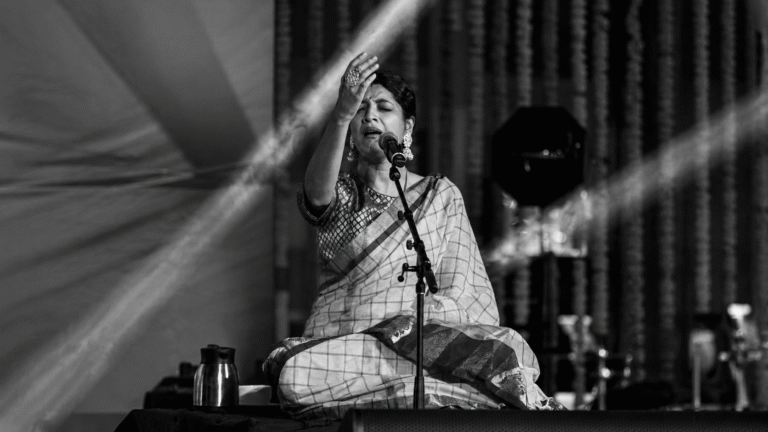
In Conversation with Dr. Sowmya Gurucharan: Music, Silence, Research and the Courage to Stay Rooted
There are musicians whose journeys are documented through concert posters, interviews, reels and carefully maintained social-media profiles. And then there are musicians such as Dr. Sowmya Gurucharan, whose music has travelled considerably farther than her digital presence.
A Carnatic classical vocalist, researcher and educationist, Sowmya has spent more than two decades immersed in Indian classical music. Her professional profile describes her as a Carnatic classical vocalist, educationist, researcher and social worker. She is also an AIR B “High” graded artist, a UGC-JRF scholar and a recipient of the Ministry of Culture Scholarship.
Yet what emerges from a long conversation with her is considerably more interesting than a list of credentials.
It is the story of a musician who began singing almost before she can remember, temporarily lost the physical ability to sing, discovered music inside silence, entered contemporary collaboration with considerable scepticism, and eventually found a way to participate without surrendering the musical identity she had spent years building.
Music Before Memory
Ask Sowmya when she started learning music, and she finds it difficult to give a conventional answer.
Her musical inheritance predates her formal training.
She comes from a Bhajana Sampradaya family. Her paternal great-grandfather, Poundarigapuram Ramakoti Veeraraghava Iyengar, was a noted Kathakalakshepam exponent. Her first guru was her paternal grandmother, Smt. Vijayalakshmi, herself trained in music. Her CV further records that Vijayalakshmi learnt under Kulitalai Krishnaswamy, a prime disciple of Mysore Vasudevachar.
During our conversation, Sowmya described music almost as something that existed in her environment before she consciously chose it.
She remembers singing from around the age of two-and-a-half or three. Music existed throughout the family, even though not everyone pursued it professionally.
In her telling, her mother was the person who recognised that the young child could perhaps be guided towards serious training.
“Probably I was getting it right from my mother’s womb itself.”
It is said jokingly, but it captures her understanding of her musical beginnings beautifully.
She is reluctant to claim too much credit for what she considers an inheritance, a circumstance and, in part, grace.
Toward the end of that answer, she reduces the musician’s contribution to something strikingly simple: what remains in one’s hands is practice.
From Her Grandmother to a Life Under Gurus
After her earliest lessons with her grandmother, Sowmya trained for many years under Sangita Vidwan S. Vishwanathan.
She recalls spending roughly thirteen years under his guidance. As he grew older and his voice and physical stamina became frailer, he himself encouraged her to continue her musical education with other teachers.
Her journey subsequently brought her under the mentorship of Dr. Ravi Kumar Malladi and Prof. Dr. P.B. Kanna Kumar at the University of Delhi. She has also pursued Konnakkol under Vidwan Shri Somashekhar Jois. Her official profile confirms these lineages and records more than 22 years of training in Carnatic Shastriya Sangeetam.
For Sowmya, however, this training is not simply an accumulation of compositions, ragas or techniques.
A recurring idea throughout the conversation is that classical music becomes meaningful when the musician gradually moves beyond reproducing what has been taught and begins asking deeper questions.
What does a phrase communicate?
What remains after technique?
What is the intention behind a musical thought?
What quality does the musician leave behind?
That distinction became particularly important after one of the most difficult periods of her musical life.
When a Singer Was Asked Not to Sing
Around 2018, Sowmya developed nodules on her vocal cords.
For a professional vocalist, the diagnosis carried implications far beyond ordinary illness. The voice was not merely a part of her body; it was the medium through which years of training had been expressed.
Her doctors discussed possible treatment, including surgery. Sowmya chose not to take the surgical route.
Instead, she embarked upon what would become an extraordinary period of enforced silence.
For almost two years, she stepped away from conventional singing.
But she does not describe those years as two years without music.
She describes them almost as the opposite.
They became two years of performing internally.
She listened.
She observed.
She revisited the music of great masters.
She asked why the music of musicians from previous generations could continue to sound profound decades after they were gone.
What made their music soulful?
Why did certain musical ideas continue to resonate?
Where did that quality come from?
Instead of practising through her physical voice, she began practising through her mind.
And that changed her relationship with music.
“Singing in the Mind”
Initially, the instruction sounded almost absurd to her.
How does a singer practise without singing?
Even humming had to be consciously controlled. Gradually, however, something changed.
Sowmya discovered that the mind was capable of concentrating on musical sound with remarkable intensity. Even surrounded by environmental noise, she could train herself to isolate the sound that mattered.
She believes that period sharpened her relationship with shruti considerably.
One of the most revealing moments in our conversation came when she described what this eventually meant to her.
Mental practice was not merely imagining a melody.
It became an attempt to absorb the tanpura and become one with its sound.
Her aspiration was almost microscopic in scale: if, in an entire musical life, one could truly become one with the tanpura for even a single note, that experience itself was meaningful.
She described such a moment as one in which she felt genuinely entitled, however briefly, to call herself a student of music.
It is a revealing choice of words.
Not master.
Not exponent.
Not accomplished performer.
Student.
From Student to Researcher
The two years of silence also changed the questions Sowmya asked of herself.
Before that experience, she says she approached music primarily as a student.
Afterwards, her relationship became closer to that of a research scholar.
She began considering not merely what should be sung, but the mental intention behind musical creation: perception, interpretation, emotional content and, ultimately, the quality that remains with the listener.
For her, the artistic question is not simply how large an audience a musician can attract.
It is what survives after the performance is over.
She credits those two years of silence with bringing her to that point.
The shift is especially interesting because research is not metaphorical in Sowmya’s life.
She holds a PhD in Carnatic Music from the University of Delhi. Her doctoral research took a multidimensional and interdisciplinary approach to musical grammar and explored significant creative dimensions of rarely sung ragas.
She has presented research at national and international forums and has written on subjects ranging from Shabda, Geya and Bhakti to Nadayoga, articulation, diction and laya.
Her academic background extends beyond music as well, including postgraduate study in education and educational management.
For her, therefore, the performer and researcher are not separate identities.
One appears to continuously interrogate the other.
Why Is Sowmya Gurucharan Almost Absent from Social Media?
There is a curious contradiction surrounding Sowmya’s digital presence.
People search for her music, but relatively little personal information about her exists online.
During our conversation, she explained that this is largely deliberate.
She is not opposed to technology. Nor does she criticise musicians who invest considerable effort in building their online identities.
She simply does not want to devote her own attention to that ecosystem.
People will have opinions about music, she says. Some will like something; others will not. She does not feel compelled to continuously respond to those opinions or allow them to redirect her attention.
Instead, she prefers to remain focused on the work she wants to do.
Her philosophy is refreshingly practical.
There are recordings of her music available publicly. Her professional contact information is available. Anyone interested in working with her can contact her directly.
In her view, an Instagram reel need not become the compulsory intermediary between a musician and an organiser.
Interestingly, she does intend to eventually create a website—not primarily as a promotional engine, but as a space where she can write about music and articulate her ideas and perceptions.
That distinction says much about her priorities.
Visibility interests her less than substance.
Meeting Anirudh Varma — and Being Sceptical of the Collective
Sowmya knew pianist and composer Anirudh Varma through the University of Delhi music circuit.
The relationship began long before she became associated with the Anirudh Varma Collective.
In fact, she laughingly remembers once storing his phone number as something resembling “Anirudh Synth”, because she knew him as a synthesiser player before properly understanding the distinction he was making between synthesiser and piano.
Behind the humour, however, she says she appreciated his perception of music and the way he thought about musical flow.
So when Anirudh began developing the idea of bringing multiple musicians together through the Collective, she found the concept fascinating.
She was also deeply sceptical.
“Will the Purity of the Raga Stay?”
Her hesitation did not arise from a dislike of collaboration.
It arose from a classical musician’s concern about identity.
Sowmya had spent much of her life listening predominantly to Carnatic and Hindustani classical music. Cinema music had never occupied a major part of her listening world.
When Anirudh proposed presenting classical material within contemporary arrangements, several questions immediately appeared in her mind.
Would the raga retain its purity?
Would the experiment do justice to the original musical design?
And perhaps most fundamentally:
Was such experimentation even necessary?
Before committing, she spoke to musician friends and examined precedents.
She looked at musicians such as Ravi Shankar, Zakir Hussain, Guitar Prasanna, Vikku Vinayakram and Aruna Sairam—artists who had collaborated across traditions without necessarily surrendering their grounding in Indian classical music.
The lesson she drew from those examples was important:
Collaboration itself was not the issue.
What you contribute to the collaboration is.
The Condition on Which She Would Collaborate
Sowmya eventually agreed to join the Anirudh Varma Collective, but she entered with an unusually clear principle.
Everything around her music could change.
The arrangement could change.
Other instruments could interact with it.
Contemporary textures could surround it.
But what came from her own voice would remain Carnatic classical music.
Her explanation during the interview was emphatic:
“If you ask me to sing Kalyani, I will only give Kalyani.”
She did not want to alter an established raga merely to make it appear more experimental.
If a genuinely new musical structure was required, she would rather research it carefully and create something with intellectual honesty than casually distort an existing identity.
That became her boundary.
And once that boundary was understood, she was ready to collaborate.
It is perhaps the most important insight into her work with the Collective.
For Sowmya, collaboration does not demand the dilution of tradition.
It demands enough confidence in tradition that one can allow other musical worlds to exist around it.
Three Tracks, and a Special Place for Stories of Kalyan
Sowmya says she has worked on only a small number of tracks with Anirudh, but all of them remain particularly close to her.
Among them, Stories of Kalyan holds a special place.
She remembers spending considerable time mentally researching what phrases she could offer and how the raga could unfold within that context.
That description connects naturally with everything else she says about her music.
She does not appear particularly interested in singing something merely because she can sing it.
The musical question comes first.
What phrase belongs here?
Why should it appear?
What is its relationship with the raga?
What does it contribute?
That is the researcher’s mind operating inside the performer.
The Larger Life Beyond Performance
Sowmya’s professional life extends significantly beyond the concert stage.
Her profile records performances for organisations including Shanmukhananda Sabha, Parthasarathy Swami Sabha, Carnatica, Delhi Tamil Sangam and several others. It also documents her collaboration with filmmaker Bharat Bala on Ganga, part of the Virtual Bharat film series.
She is also involved with Sri Hayagriva, a New Delhi-based nonprofit society founded by her father, Shri R. Gurucharan. The organisation works to promote Indian classical art forms among younger audiences while also supporting educational needs of underprivileged children.
Her interests extend further still: her profile identifies her as a Kalaripayattu practitioner and records her continuing studies in Naturopathy and Yoga Sciences.
None of these appear, however, to displace the central thread running through her life.
Music remains the axis.
What Two Years of Silence Ultimately Gave Her
Perhaps the easiest way to understand Sowmya Gurucharan is through the paradox at the centre of her journey.
Some of her deepest musical development happened when she could not sing.
The vocal-cord injury could easily have been remembered simply as an interruption—a period that delayed a performing career.
She speaks about it differently.
It became a period of observation.
A period of listening.
A period of asking questions.
A period of discovering what the mind could hear without the voice producing a sound.
And eventually, a period that helped her distinguish between executing music and understanding music.
There is another layer to this story too.
During our conversation, she briefly reflected upon the sacrifices her parents had made to provide opportunities for their children. Financial struggles, years of training and the accumulated effort surrounding a musical life could, in her mind, suddenly feel justified by one genuine moment of musical alignment.
That may explain why her idea of success sounds different from many contemporary definitions of a musical career.
She does not reduce it to numbers.
Not followers.
Not the size of a crowd.
Not visibility for visibility’s sake.
The question she appears more interested in asking is quieter:
What quality remains in the music?
And perhaps that is also why a musician with almost no conventional social-media presence continues to be searched for by listeners who encounter her work.
The digital footprint may be small.
The musical impression evidently is not.
About Dr. Sowmya Gurucharan
Dr. Sowmya Gurucharan is a Carnatic classical vocalist, researcher and educationist. She holds a PhD in Music from the University of Delhi and has trained under several distinguished gurus, including Sangita Vidwan S. Vishwanathan, Dr. Ravi Kumar Malladi and Prof. Dr. P.B. Kanna Kumar. She is an AIR B “High” graded artist, a UGC-JRF scholar and a Ministry of Culture Scholarship recipient.