Introduction: Why Hindustani Classical Vocal Training Still Matters
Hindustani Classical Vocal Classes in New Delhi are becoming more relevant than ever because people are looking for learning that goes deeper than casual singing. Today, many students can sing songs from social media, film music, or short reels, but very few understand the foundation behind voice, pitch, rhythm, and expression. That’s where Hindustani classical vocal training becomes truly powerful.
Hindustani classical music is not just about singing notes. It’s about learning how to listen, breathe, feel, and express with honesty. It teaches patience, discipline, and sensitivity. It also builds a strong base for almost every other form of music, including light classical, ghazal, bhajan, semi-classical, Bollywood, fusion, and even contemporary singing.
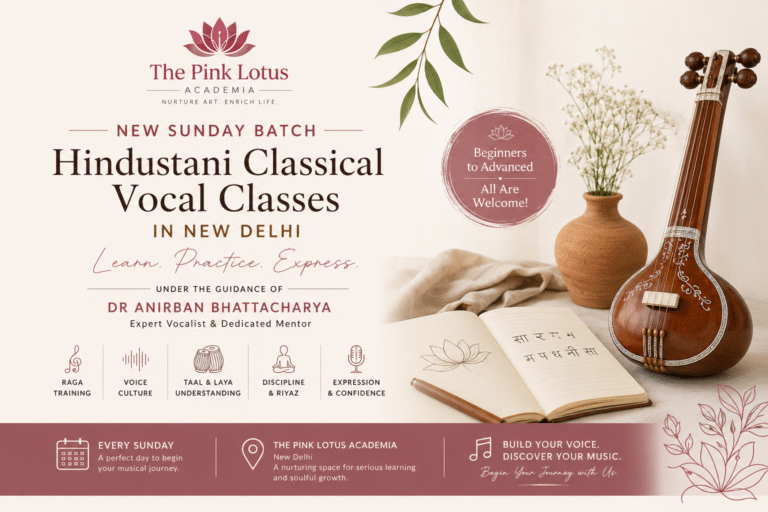
The Pink Lotus Academia has now started a new Sunday batch for Hindustani Classical Vocal Classes in New Delhi under the guidance of Dr Anirban Bhattacharya. This batch is designed for students who want to learn properly, step by step. It’s not a random singing class. It’s a structured journey into sur, laya, raga, bandish, voice culture, and musical expression.
In a city like New Delhi, where students and professionals often have packed schedules, a Sunday batch makes classical music learning more practical. You don’t have to rush after work or school. You can come with a fresh mind, learn deeply, and carry the practice into your week.
The beauty of Hindustani classical vocals is that it welcomes both beginners and serious learners. You don’t need to be born with a “perfect voice” to start. In fact, a good voice is developed through practice, listening, correction, and consistent riyaz. With the right teacher, even a hesitant beginner can slowly build confidence.
The Sangeet Natak Akademi, India’s national academy for performing arts, describes Indian classical music as an oral tradition where students learn closely from a guru and develop a deep musical and spiritual bond through years of training. For reference, you can explore their official page on music here: Sangeet Natak Akademi – Music.
That same spirit of guided learning is important at The Pink Lotus Academia. The goal is not only to teach songs. The goal is to build musicianship.
About The Pink Lotus Academia’s New Sunday Vocal Batch
The new Sunday batch at The Pink Lotus Academia is created for students who want to begin or deepen their Hindustani classical vocal journey in a serious yet comfortable environment. Many people want to learn classical music but delay it because they feel it’s too difficult, too traditional, or only meant for people who started as children. That’s not true.
Hindustani classical vocals can be learned at many stages of life. Children, teenagers, college students, working professionals, homemakers, and senior learners can all benefit from structured vocal training. What matters most is regular practice and proper guidance.
A Structured Weekend Learning Opportunity
Sunday classes are ideal because they give students time and mental space. Music requires attention. When students are relaxed, they absorb better. A Sunday batch also helps working professionals and school students maintain consistency.
Instead of fitting music into a tired weekday evening, students can come with more focus. This makes the learning more meaningful.
A weekend batch also gives students a full week to practice what they learn. They can revise sargam, alankar, voice exercises, and bandish at home before the next class.
Learn Under Dr Anirban Bhattacharya
The new Sunday batch is led by Dr Anirban Bhattacharya. Having a dedicated teacher matters greatly in Hindustani classical music. Vocal training is not something students can learn fully by watching random videos. Online videos can inspire, but they can’t correct your sur, breathing, posture, pronunciation, or raga approach in real time.
A teacher listens to the student carefully. They understand where the voice is stuck, where the pitch is unstable, and where the student needs more practice. This kind of correction is priceless.
Under Dr Anirban Bhattacharya’s guidance, students can expect a structured approach to voice training, raga learning, sargam practice, bandish, and musical discipline.
Who Can Join This Batch?
The Sunday vocal batch is suitable for:
| Student Type | Why This Batch Helps |
| Beginners | Learn from the foundation without fear |
| Children | Build early musical discipline |
| Teenagers | Improve voice, confidence, and focus |
| Adults | Start or restart music in a structured way |
| Working professionals | Learn on Sundays without weekday pressure |
| Semi-classical singers | Strengthen classical base |
| Music lovers | Understand raga, sur, and bandish deeply |
The best part is that students don’t need to know everything before joining. They only need interest, patience, and willingness to practice.
What Makes Hindustani Classical Vocals So Special?
Hindustani classical vocals are among the most refined musical traditions of India. This music is based on ragas, talas, voice culture, improvisation, and emotional expression. Unlike many forms of music that focus mainly on fixed songs, Hindustani classical music teaches students how to explore sound itself.
The Beauty of Raga-Based Music
A raga is not just a scale. It has mood, movement, character, and emotional colour. Every raga has its own personality. Some ragas feel peaceful. Some feel devotional. Some feel romantic. Some feel serious. Some feel bright and energetic.
When students learn ragas, they learn how notes behave. They understand which notes are important, how to approach them, how to rest on them, and how to create musical phrases.
This is why Hindustani classical vocal training develops deep musical intelligence. Students don’t just memorize. They understand.
The Role of Sur and Laya
Two of the most important pillars of Hindustani classical music are sur and laya.
Sur means pitch. It teaches students to sing in tune. Without sur, singing feels unstable. With sur, even a simple phrase becomes beautiful.
Laya means rhythm or tempo. It teaches students timing, balance, and control. A singer must learn how to stay with the taal while still expressing freely.
At The Pink Lotus Academia, students are encouraged to develop both sur and laya through regular exercises, alankars, sargam, and compositions.
The Guru-Shishya Learning Approach
Hindustani classical music has always valued the bond between teacher and student. This doesn’t mean modern students must live with their guru like in ancient times. But the spirit of personal guidance remains important.
A good teacher shapes the student’s voice, listening habits, discipline, and musical taste. The teacher also helps the student avoid shortcuts that can damage long-term learning.
In classical vocals, slow learning is not a weakness. It’s the right way. The voice matures with time.
9 Powerful Reasons to Join Hindustani Classical Vocal Classes in New Delhi
1. Builds a Strong Foundation in Sur
The first reason to join Hindustani Classical Vocal Classes in New Delhi at The Pink Lotus Academia is the foundation in sur. Many singers struggle because they sing without stable pitch. Classical training helps correct this from the root.
Students learn how to identify notes, hold notes, and move between them with control.
2. Improves Voice Control and Breath
Voice is not only about the throat. It also involves breath, posture, resonance, and relaxation. Through regular vocal exercises, students learn how to sing without unnecessary strain.
Good breath control helps singers hold notes longer, sing phrases smoothly, and avoid forcing the voice.
3. Develops Musical Discipline
Classical music teaches discipline through riyaz. Riyaz means regular practice. It may sound simple, but it changes everything.
Even 20 to 30 minutes of focused daily practice can improve the voice over time. Students become more patient, alert, and dedicated.
4. Helps You Understand Ragas
Ragas are the soul of Hindustani classical music. In the Sunday batch, students can slowly learn how ragas are introduced, developed, and expressed.
This helps them go beyond surface-level singing. They begin to understand why a note feels a certain way and how a phrase creates emotion.
5. Improves Confidence in Singing
Many students are shy about singing. They may fear singing out of tune or making mistakes. A supportive class environment helps reduce that fear.
As students improve their sur, voice, and understanding, their confidence grows naturally.
6. Supports Emotional Expression
Music is not just technical. It’s emotional. Hindustani classical vocals help students express bhava, or feeling, through notes and phrases.
This makes singing more meaningful. Students learn not only what to sing but how to feel it.
7. Strengthens Listening Skills
A good singer must also be a good listener. Classical training improves the ear. Students learn to recognize notes, phrases, rhythm cycles, and subtle movements in melody.
This listening skill helps in all forms of music.
8. Connects You to Indian Culture
Hindustani classical music carries centuries of Indian artistic wisdom. Learning it connects students to ragas, poetry, taal, language, devotion, and tradition.
For children especially, this creates cultural grounding in a beautiful way.
9. Creates a Lifelong Musical Journey
Classical music is not a quick course. It’s a lifelong journey. And that’s the best thing about it.
Students can keep growing for years. There is always another raga, another bandish, another nuance, another layer to discover.
What Students Learn in the Sunday Batch
The Sunday batch at The Pink Lotus Academia is designed to give students a clear and practical learning structure. Instead of confusing beginners with too much theory, the class can help students build gradually.
Voice Warm-Ups and Basic Riyaz
Every vocal journey begins with the voice. Students learn warm-ups that prepare the voice for singing. These may include basic swara practice, long note holding, breath awareness, and simple movement between notes.
This helps create stability and control.
Alankars and Sargam Practice
Alankars are note patterns that train the voice. They help improve pitch, speed, clarity, and movement. Sargam practice teaches students how to sing notes with accuracy.
This is like grammar for music. Without it, singing can remain loose. With it, singing becomes cleaner.
Raga Introduction
Students are gradually introduced to ragas. They learn the basic structure, important notes, common phrases, and mood of the raga.
For beginners, this slow introduction is very important. It prevents confusion and builds respect for the form.
Bandish Learning
A bandish is a fixed composition in a raga. It gives the student a musical framework. Through bandish, students learn melody, rhythm, words, expression, and improvisation possibilities.
Bandish learning is one of the most enjoyable parts of vocal training.
Taal and Laya Understanding
Students also learn how rhythm works. They begin to understand taal, matra, sam, khali, and basic rhythmic awareness.
This helps them sing with structure instead of floating freely without control.
Why The Pink Lotus Academia Is One of the Best Institutes for Music in New Delhi
The Pink Lotus Academia is known for creating a thoughtful learning space for Indian classical arts, yoga, and performing traditions. For music students, the environment matters as much as the teacher. A serious art needs a serious space, but it should also feel welcoming.
Expert Faculty
The new Sunday batch by Dr Anirban Bhattacharya gives students access to guided classical vocal learning. Expert faculty can help students avoid common mistakes and build correct habits from the beginning.
This is especially important in vocal music because the voice is delicate. Wrong practice can create strain, while correct practice builds strength and beauty.
One-on-One Attention
Even in a group class, personal attention is important. Every student has a different voice. Some have pitch issues. Some need breath control. Some need confidence. Some need clarity in pronunciation.
The Pink Lotus Academia focuses on guided learning, not mechanical teaching.
Beginner-Friendly Environment
Many beginners feel nervous before joining a classical music class. They may think everyone else will be better. But a good institute makes beginners feel safe.
At The Pink Lotus Academia, students can learn without embarrassment. Mistakes are part of the process.
Serious Yet Warm Learning Space
The best music learning happens when discipline and warmth come together. Too much pressure can scare students away. Too little discipline can stop growth.
The Pink Lotus Academia balances both. Students are encouraged to enjoy music while also respecting regular practice.
How to Start Your Hindustani Classical Vocal Journey
Starting Hindustani classical vocals is simple, but continuing requires patience. Here’s how beginners can begin well.
Start with Patience
Don’t expect instant results. Classical music grows slowly. The first few months are about building sur, listening, breath, and confidence.
That foundation will support everything later.
Practice Daily
Daily riyaz is more useful than occasional long practice. Even a short daily session can create improvement.
A simple routine may include:
| Practice Area | Suggested Time |
| Long notes | 5 minutes |
| Sargam | 10 minutes |
| Alankar | 10 minutes |
| Bandish revision | 10 minutes |
| Listening | 10 minutes |
Listen to Great Vocalists
Listening is a part of learning. Students should listen to classical vocalists regularly. This builds taste, ear training, and understanding of raga expression.
Trust the Process
There will be days when the voice feels good and days when it doesn’t. That’s normal. The key is to continue.
As they say, little by little, a little becomes a lot.
FAQs About Hindustani Classical Vocal Classes in New Delhi
1. Who is teaching the new Sunday batch at The Pink Lotus Academia?
The new Sunday batch for Hindustani classical vocals at The Pink Lotus Academia is led by Dr Anirban Bhattacharya.
2. Can beginners join Hindustani Classical Vocal Classes in New Delhi?
Yes, beginners can join. The Sunday batch is suitable for students who want to start from the basics and build a strong foundation.
3. Do I need a naturally good voice to learn classical singing?
No. A good singing voice is developed through training, listening, breath control, and regular riyaz. You don’t need to be perfect before starting.
4. Is the Sunday batch suitable for working professionals?
Yes, the Sunday batch is a practical option for working professionals who may not be able to attend weekday classes.
5. What will students learn in the vocal classes?
Students can learn voice culture, sargam, alankar, raga basics, bandish, taal, laya, listening skills, and performance confidence.
6. Is Hindustani classical vocal training useful for Bollywood or light music?
Yes. Hindustani classical training builds a strong foundation in sur, rhythm, breath, and expression. This helps in many singing styles, including Bollywood, ghazal, bhajan, and semi-classical music.
7. Can children join the Sunday vocal batch?
Yes, children can benefit from classical vocal training because it improves focus, listening, discipline, and musical confidence.
8. Where is The Pink Lotus Academia located?
The Pink Lotus Academia is located in New Delhi and offers structured learning in Indian classical music and wellness arts.
Conclusion: Begin Your Sunday Vocal Journey at The Pink Lotus Academia
Hindustani Classical Vocal Classes in New Delhi are a beautiful opportunity for anyone who wants to learn music deeply and correctly. The new Sunday batch at The Pink Lotus Academia by Dr Anirban Bhattacharya gives students a chance to begin their journey with proper guidance, structure, and care.
Whether you are a beginner, a parent, a working professional, or a passionate music lover, this batch can help you build a strong foundation in sur, laya, raga, voice culture, and expression.
Music is not something you need to chase in a hurry. It grows with you. With the right teacher and the right environment, your voice can become more confident, more expressive, and more connected to the tradition of Hindustani classical music.
Join the new Sunday Hindustani Classical Vocal batch at The Pink Lotus Academia and begin a musical journey rooted in tradition, discipline, and soulful expression.