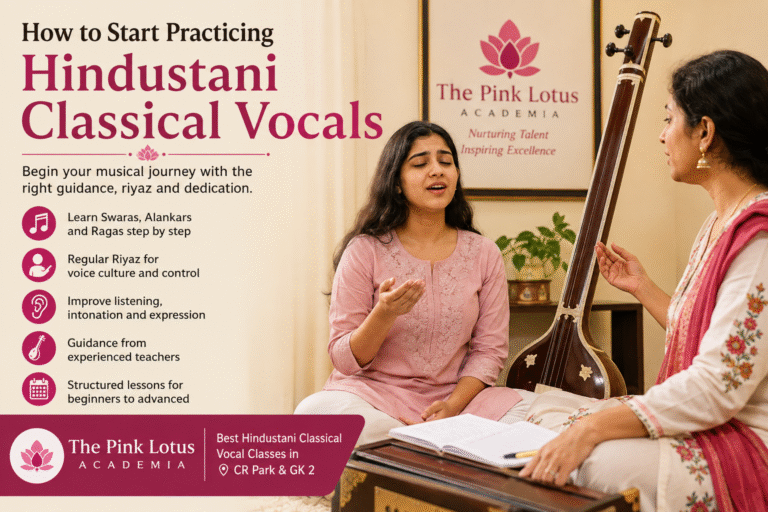
Learning Hindustani Classical Vocal music can be a deeply rewarding musical journey. However, beginners often wonder where to start.
A structured approach makes the learning process easier and more enjoyable. Moreover, regular guidance helps students develop correct habits from the beginning.
If you live around CR Park or GK 2, professional training is easily accessible. The Pink Lotus Academia offers structured Hindustani Classical Vocal classes for students across different age groups and experience levels.
Start by Understanding the Basics of Hindustani Classical Vocals
Before singing complex compositions, students should first understand the basic notes of Indian classical music.
The seven primary swaras are Sa, Re, Ga, Ma, Pa, Dha, and Ni. Therefore, beginners should become comfortable identifying and singing these notes.
Initially, students should focus on producing clear and stable notes. Accuracy matters more than speed during this stage.
Additionally, beginners should learn how notes relate to the chosen tonic or Sa. This understanding creates a strong foundation for future raga training.
Begin Your Daily Vocal Riyaz with Sa
Every effective Hindustani Classical Vocal practice session should begin calmly.
Start by establishing your Sa with the help of a tanpura or electronic tanpura. Then, listen carefully before singing.
Your voice should gradually settle into the tonal environment. Consequently, your ears and voice begin working together.
Avoid immediately attempting fast exercises. Instead, allow the voice enough time to open naturally.
Regular practice of sustained notes can also improve stability. Furthermore, it develops better control over pitch and breath.
Practice Alankars and Palta Exercises Regularly
Alankars and paltas play an important role in Hindustani Classical Vocal training.
These exercises help students understand different combinations of swaras. Moreover, they gradually improve vocal flexibility and accuracy.
Begin slowly and maintain clarity throughout the exercise. Once comfortable, increase the tempo under your teacher’s guidance.
However, speed should never replace musical precision. Every note should remain clearly audible and correctly pitched.
Regular palta practice can also strengthen your understanding of melodic movement.
Develop Your Ear Alongside Your Voice
Hindustani Classical Music requires active listening.
Therefore, vocal training should never depend only on repeating exercises. Students must also learn to hear subtle differences between notes.
Listen carefully to your teacher during lessons. Additionally, spend time listening to accomplished Hindustani Classical Vocalists.
Over time, this practice develops musical sensitivity. It also helps students understand intonation, phrasing, ornamentation, and raga movement.
A trained ear eventually makes self-correction easier during daily riyaz.
Learn Ragas Step by Step
Raga training should begin gradually.
First, understand the basic structure of the raga. Then, learn its ascending and descending movements where applicable.
Students should also understand important phrases and characteristic movements. Consequently, the raga starts becoming a musical personality rather than a scale.
Afterwards, students can explore compositions, alaap, taans, and improvisation according to their level.
However, every raga requires patience. Therefore, beginners should avoid learning too many ragas simultaneously.
Create a Consistent Hindustani Vocal Riyaz Routine
Consistency is more valuable than occasional long practice sessions.
A beginner can start with approximately 20 to 30 minutes of focused daily practice. Gradually, practice duration can increase according to the teacher’s advice.
Your routine can include basic swara practice, alankars, paltas, and material taught during class.
Additionally, recording your practice occasionally can be useful. Listening afterwards may reveal pitch or rhythm problems unnoticed while singing.
Most importantly, regularity builds musical memory.
Why Learning with a Guru Matters
Indian classical music has traditionally developed through the Guru-Shishya learning system.
Although technology has changed how lessons happen, individual guidance remains extremely important.
A trained teacher can identify problems with pitch, voice production, rhythm, and technique. Furthermore, the teacher can select exercises suitable for each student.
Without guidance, beginners may unknowingly repeat incorrect habits. Those habits can become difficult to change later.
Therefore, structured training creates a clearer path for musical development.
Learn Hindustani Classical Vocals in CR Park and GK 2
For students searching for Hindustani Classical Vocal classes in CR Park, location and teaching quality both matter.
Similarly, learners searching for vocal classes in GK 2 often want accessible and structured training.
The Pink Lotus Academia offers Hindustani Classical Vocal training for students who want to build strong musical foundations.
The academy provides an environment where students can learn systematically while developing confidence and musical understanding.
Moreover, students can progress from foundational exercises towards raga-based learning under experienced guidance.
Why Choose The Pink Lotus Academia for Vocal Classes?
The Pink Lotus Academia focuses on structured learning while respecting the traditional foundations of Hindustani Classical Music.
Students receive guidance according to their existing musical level. Therefore, complete beginners can start without feeling overwhelmed.
At the same time, continuing learners can strengthen their understanding of swaras, ragas, rhythm, and performance.
The academy’s location also makes it convenient for learners around CR Park, GK 2, Greater Kailash, Kalkaji, and nearby South Delhi areas.
For anyone searching for the best Hindustani Classical Vocal classes in CR Park and GK 2, The Pink Lotus Academia offers a focused environment for serious musical learning.
Start Your Hindustani Classical Vocal Journey
You do not need an extraordinary voice to begin learning Indian classical music.
Instead, you need patience, regular practice, attentive listening, and good guidance.
Start with Sa. Develop your swaras carefully. Practice consistently and allow your musical understanding to grow naturally.
Most importantly, enjoy the process.
If you are looking for Hindustani Classical Vocal classes in CR Park or GK 2, begin your musical journey with The Pink Lotus Academia and discover the depth of Indian classical music.