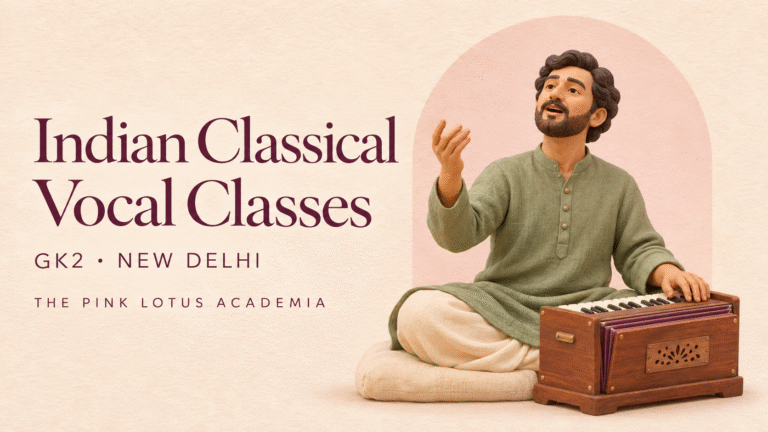
Indian classical vocal classes in GK2 can help you turn a love of singing into a regular musical practice. Perhaps you enjoy humming familiar melodies or listening closely to a beautifully sung raag. With guidance, that interest can grow into a deeper understanding of your own voice.
The Pink Lotus Academia offers Hindustani classical vocal training in Greater Kailash II, New Delhi. Its programme covers musical foundations, voice development, and raag-based learning. thepinklotusacademia.com
Whether you are starting afresh or returning to music, begin with curiosity and a willingness to listen.
Learn Hindustani Classical Singing in Greater Kailash II
A satisfying singing lesson gives you something clear to work on. First, you learn to recognise what you hear. Then, you explore how to reproduce it with greater accuracy and expression.
At The Pink Lotus Academia, the Hindustani vocal programme brings together sur, taal, sargam, alankars, bandish, and improvisation. Additionally, students can interact with the educator and ask questions during lessons. thepinklotusacademia.com
That exchange makes learning more purposeful. For example, a teacher can help you identify where a phrase loses pitch or rhythmic clarity. You leave with a specific detail to revisit during practice.
Study with Dr. Anirban Bhattacharyya
The academy lists Dr. Anirban Bhattacharyya as its Hindustani classical vocal faculty. He belongs to the Patiala tradition and is a senior disciple of Pandit Ajoy Chakraborty. thepinklotusacademia.com
Learning within a musical lineage introduces students to an established approach to expression and interpretation. Moreover, it offers context for the phrases, compositions, and stylistic choices you encounter.
As you study, listen carefully to demonstrations. Notice how the teacher shapes a note, connects a phrase, and gives space to the music.
What You Learn in Classical Vocal Classes
A strong musical foundation grows through several connected skills. Consequently, progress involves listening, singing, rhythm, and thoughtful repetition.
Sur, Swara, and Sargam
Pitch awareness begins with hearing notes clearly and recognising their relationships. Sargam uses the familiar syllables Sa, Re, Ga, Ma, Pa, Dha, and Ni.
During practice, give each note your full attention. Next, work through the patterns your teacher assigns.
Alankar exercises provide structured note patterns for practice. However, speed should follow clarity. A short phrase sung steadily gives you a useful starting point for further development.
Raag, Taal, and Bandish
Each raag carries a melodic identity, including characteristic phrases and ways of approaching notes. Meanwhile, taal organises rhythm through a repeating cycle.
A bandish brings a composition into that relationship between melody and rhythm. Through it, students explore how musical ideas take shape within a raag and taal. The Pink Lotus Academia
For example, listen to how a phrase moves towards an important beat. Then, repeat it slowly while maintaining awareness of the rhythmic cycle.
Voice Training and Musical Expression
The academy’s programme includes voice culture, breathing, and vocal modulation. It also introduces expressive elements such as alaap and taan. thepinklotusacademia.com
Alongside these studies, pay attention to phrasing and clear pronunciation. Ask your teacher how to approach passages that feel difficult.
Similarly, keep the musical meaning in mind while working on technique. A thoughtful phrase needs both control and a sense of direction.
Singing Lessons for Beginners and Returning Learners
Beginners can approach classical singing one small task at a time. First, become familiar with the exercises and musical vocabulary your teacher introduces.
If you have studied before, share your experience and the material you remember. This helps establish a useful starting point.
Adults returning after a long break can also begin with manageable goals. Rather than comparing your voice with someone else’s, notice changes in your own practice.
For instance, you might recognise a pitch more quickly or remember a phrase more accurately. These observations give progress a practical meaning.
Choose Online or In-Person Vocal Classes
The Pink Lotus Academia offers both online and offline Hindustani classical vocal classes. Therefore, you can enquire about the format that suits your location and routine. thepinklotusacademia.com
For online learning, prepare a quiet space and check your audio connection before class. Meanwhile, attending in GK2 gives local learners the option of studying at the academy.
Confirm current batch timings, fees, and availability before enrolling.
Make Riyaz Part of Your Week
Regular riyaz gives classroom learning a place in everyday life. Start with the material your teacher recommends and keep your practice focused.
Next, choose one clear priority for the session. You might revisit an alankar, remember a bandish phrase, or follow a rhythmic cycle.
Also, keep brief notes about corrections and questions. When something remains unclear, bring it to your next lesson.
Over time, this cycle of listening, practice, and feedback can make your learning more deliberate.
Join Indian Classical Vocal Classes in GK2
Explore Indian classical vocal classes in GK2 with The Pink Lotus Academia and give your musical interests regular attention. Whether you enjoy singing privately or hope to perform eventually, a thoughtful foundation provides direction.
Visit the academy in Greater Kailash II, New Delhi, or explore its Hindustani classical vocal programme.
Finally, take the next step by contacting the team about an appropriate batch. Bring your questions, your interest, and your willingness to practise.