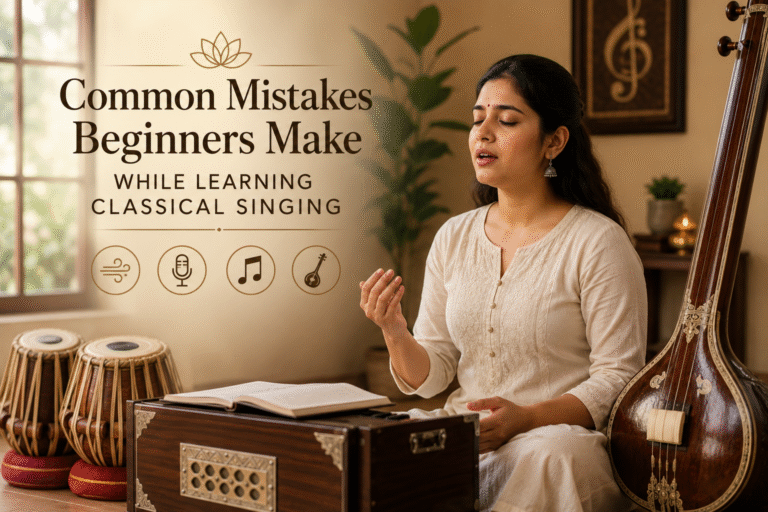
Starting Your Classical Singing Journey the Right Way
Learning Hindustani Classical Singing is a rewarding experience. However, every beginner faces challenges during the early stages. Small mistakes can slow progress if they remain unnoticed. Fortunately, most of these habits are easy to correct with proper guidance.
Every accomplished vocalist once faced similar struggles. Therefore, beginners should focus on learning patiently instead of chasing perfection. Consistent effort always produces better results than occasional intensive practice.
Skipping Daily Riyaz
Many beginners believe weekly classes are enough. Unfortunately, improvement depends on regular practice outside the classroom.
Daily Riyaz strengthens pitch, breath control, and vocal stability. Even thirty minutes of focused practice creates lasting progress. Moreover, consistent practice develops confidence with every session.
A simple daily routine always outperforms irregular long practice sessions.
Trying to Sing Difficult Ragas Too Early
Many students become excited after learning basic notes. Consequently, they attempt advanced ragas before mastering the fundamentals.
Strong foundations always produce better musicians. Therefore, beginners should first become comfortable with Swaras, Alankars, and simple compositions.
Patience eventually leads to faster progress.
Ignoring Voice Culture Exercises
Voice culture forms the backbone of classical singing. However, beginners often underestimate its importance.
Simple exercises improve vocal flexibility, resonance, and breath control. Furthermore, they prepare the voice for longer practice sessions.
A healthy voice develops gradually through proper training.
Neglecting Breath Control
Breathing affects every aspect of singing. Nevertheless, many students focus only on hitting the correct notes.
Controlled breathing supports longer phrases and smoother vocal delivery. Additionally, proper breathing reduces unnecessary strain on the throat.
Good singers learn to breathe as naturally as they sing.
Practising Without a Tanpura
The Tanpura provides a constant reference for pitch. Yet, many beginners practise without this essential support.
Regular practice with a Tanpura improves listening ability and pitch accuracy. Consequently, students develop stronger musical ears over time.
Today, several excellent digital Tanpura applications make practice convenient.
Focusing on Speed Instead of Accuracy
Fast singing often impresses beginners. However, speed without clarity creates poor musical habits.
Every note should sound clear and accurate. Therefore, students should sing slowly before increasing speed.
Precision always comes before velocity in classical music.
Comparing Yourself with Others
Every learner progresses differently. Unfortunately, constant comparison often reduces confidence.
Some students develop quickly, while others improve steadily. Both journeys are equally valuable.
Instead, compare today’s performance with yesterday’s practice. Gradual improvement builds lasting motivation.
Ignoring Feedback from the Guru
Constructive feedback accelerates learning. Nevertheless, beginners sometimes repeat old habits despite regular corrections.
Listening carefully during every class creates noticeable improvement. Moreover, applying feedback immediately prevents long-term mistakes.
A good student remains open to continuous learning.
Not Listening to Great Classical Musicians
Listening develops musical understanding beyond classroom learning. However, many beginners only practise without listening.
Regular exposure to legendary vocalists improves phrasing, expression, and tonal quality. Additionally, students naturally absorb musical aesthetics.
Listening should become part of every daily Riyaz routine.
Expecting Instant Results
Classical singing requires dedication and consistency. Unfortunately, many beginners expect dramatic improvement within a few weeks.
Progress happens gradually through disciplined practice. Consequently, every small improvement becomes a meaningful milestone.
Music rewards patience more than speed.
Choosing the Wrong Learning Environment
Learning from experienced teachers makes a significant difference. A structured curriculum helps beginners avoid confusion and develop proper technique.
An encouraging learning environment also builds confidence. Furthermore, personalised guidance helps students overcome individual challenges.
Choosing the right academy often determines long-term success.
How to Avoid These Mistakes
Every beginner can improve by following a few simple habits:
- Practise Riyaz every day.
- Focus on correct pitch before speed.
- Learn fundamentals thoroughly.
- Use a Tanpura during practice.
- Perform regular breathing exercises.
- Listen to accomplished classical vocalists.
- Accept feedback positively.
- Stay patient throughout the learning journey.
- Follow a structured curriculum.
- Enjoy the process of learning music.
These habits create a strong musical foundation for lifelong growth.
Begin Your Classical Singing Journey with Confidence
Every beginner makes mistakes. However, each mistake becomes an opportunity to learn and improve.
Classical singing is not about perfection. Instead, it is about steady progress through disciplined practice and expert guidance.
With regular Riyaz, proper technique, and the right teacher, every student can develop a confident and expressive voice.
Your musical journey begins with one lesson, one note, and one consistent step forward.