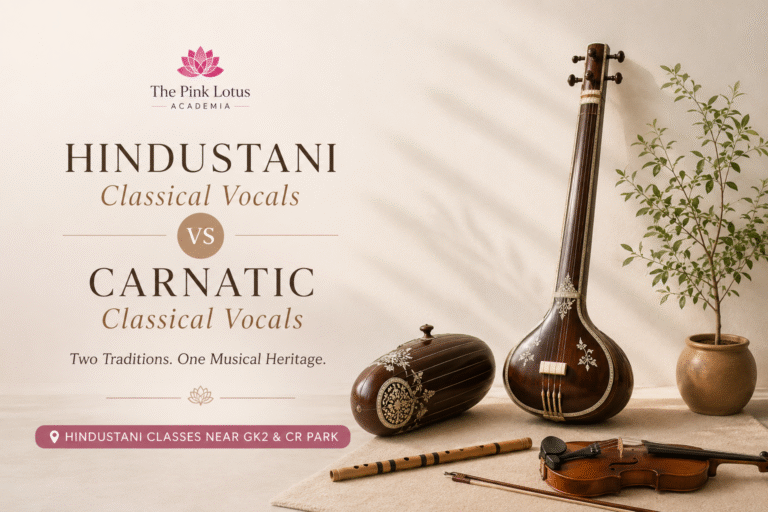
Difference Between Hindustani Classical Vocals and Carnatic Vocals
Indian classical music represents one of the world’s richest musical traditions. However, it developed into two distinct systems over time. These are Hindustani Classical Music and Carnatic Classical Music.
Both traditions share the same roots. Nevertheless, each offers a unique musical experience. Therefore, choosing the right learning path depends on your interests and musical goals.
At The Pink Lotus Academia, students can learn both Hindustani Classical Vocals and Carnatic Vocals under expert guidance. Additionally, the academy offers Hindustani Classical Vocal classes near GK2 and CR Park, making quality music education easily accessible in South Delhi.
The Origin of Both Traditions
Both musical systems originated from ancient Indian classical traditions.
Over centuries, regional influences shaped their evolution. Consequently, Hindustani music flourished in North India. Meanwhile, Carnatic music developed in South India.
Despite these differences, both preserve the essence of Indian classical music.
Musical Style and Expression
Hindustani Classical Music emphasizes gradual development and improvisation.
Every performance unfolds patiently with emotional depth. Furthermore, artists explore a raag through slow progression before increasing complexity.
Carnatic music follows a structured presentation. Moreover, compositions play a central role throughout the performance.
Both styles demand discipline and creativity.
Improvisation Techniques
Improvisation remains essential in both traditions.
Hindustani musicians expand a raag with detailed alaap, taans, and bol-alaps. Consequently, performances often feel spacious and meditative.
Carnatic musicians use techniques such as alapana, niraval, and kalpana swaras. Therefore, performances become rhythmically dynamic and highly energetic.
Rhythm and Taal
Rhythm forms the backbone of Indian classical music.
Hindustani music commonly features taals like Teentaal, Ektaal, Jhaptaal, and Rupak. Additionally, rhythm gradually supports melodic development.
Carnatic music explores intricate rhythmic structures with remarkable mathematical precision. As a result, rhythmic improvisation becomes highly sophisticated.
Language of Compositions
Language differs between both traditions.
Hindustani compositions often use Hindi, Braj Bhasha, Urdu, Sanskrit, and Persian influences.
Carnatic compositions mainly feature Sanskrit, Telugu, Tamil, and Kannada. Consequently, each tradition reflects its regional heritage beautifully.
Voice Training Methods
Both traditions emphasize systematic voice development.
Hindustani training focuses on swar sadhana, aakar practice, meend, breath control, and tonal purity. Therefore, students build expressive singing voices.
Carnatic training develops speed, precision, gamakas, and rhythmic control. Likewise, consistent practice strengthens vocal flexibility.
Performance Structure
Every concert follows its own tradition.
Hindustani performances usually begin with a slow alaap. Afterwards, compositions gradually progress through different tempos.
Carnatic concerts include several compositions presented in a planned sequence. Furthermore, rhythmic exchanges create exciting musical moments.
Instruments Used
Both traditions use beautiful accompanying instruments.
Hindustani vocal performances commonly feature harmonium, tabla, tanpura, and sarangi.
Carnatic concerts usually include violin, mridangam, ghatam, kanjira, and tanpura.
Each ensemble enhances the musical experience.
Which Style Should You Learn?
Every learner has unique musical aspirations.
Choose Hindustani music if you enjoy expansive improvisation and meditative melodies.
Choose Carnatic music if you appreciate structured compositions and rhythmic complexity.
Many students eventually explore both traditions. Therefore, learning either style creates a strong musical foundation.
Learn Hindustani and Carnatic Music at The Pink Lotus Academia
The Pink Lotus Academia proudly teaches both Hindustani Classical Vocals and Carnatic Vocals.
Students receive expert instruction through structured lessons and practical training. Moreover, every class encourages consistent growth and musical confidence.
The academy also offers new Hindustani Classical Vocal classes near GK2 and CR Park. Consequently, students across South Delhi can learn from experienced faculty in a peaceful environment.
Why Choose The Pink Lotus Academia?
Students trust The Pink Lotus Academia because of its commitment to excellence.
Highlights include:
- Expert vocal faculty
- Hindustani and Carnatic vocal training
- New Hindustani classes near GK2 and CR Park
- Beginner to advanced programs
- Individual attention
- Small batch sizes
- Peaceful learning environment
- Offline and online learning options
- Strong focus on traditional Indian classical music
Every class inspires confidence, discipline, and artistic growth.
Begin Your Journey in Indian Classical Music
Indian classical music offers a lifetime of learning and discovery.
Whether you choose Hindustani Classical Vocals or Carnatic Vocals, every lesson strengthens your musical foundation. The Pink Lotus Academia provides expert guidance, structured training, and a welcoming environment for learners of all ages. If you are looking for the best place to learn Indian Classical Music, the academy offers the perfect beginning for your musical journey.