What Is the Circle of Fifths?
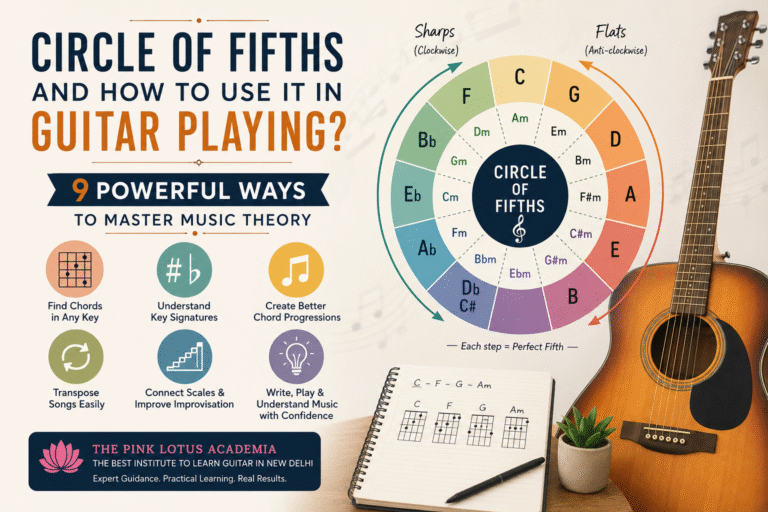
The Circle of Fifths is a visual arrangement of the 12 musical notes. These notes are placed in a circular pattern, where each note is a perfect fifth apart from the next note. In simple words, if you start from C and move clockwise, the next note is G. From G, the next note is D. Then A, E, B, F#, C#, and so on.
Now, don’t worry if that sounds technical. Think of the Circle of Fifths as a music map. Just like Google Maps helps you understand routes, the Circle of Fifths helps you understand how notes, keys, chords, and scales are connected.
For guitar players, this tool is especially powerful. The guitar fretboard can feel like a puzzle. You may know a few open chords, some barre chords, and a handful of scales. But without theory, these things can feel disconnected. The Circle of Fifths helps bring everything together.
Why Is It Called a Circle?
It’s called a circle because all 12 notes eventually return to the starting point. If you move clockwise by fifths, you go through every key and come back to C. If you move anti-clockwise, you move by fourths. This is equally useful because many common chord progressions move in fourths.
Here’s the common clockwise order:
| Position | Note |
| 1 | C |
| 2 | G |
| 3 | D |
| 4 | A |
| 5 | E |
| 6 | B |
| 7 | F# / Gb |
| 8 | Db |
| 9 | Ab |
| 10 | Eb |
| 11 | Bb |
| 12 | F |
On a guitar, this matters because many songs use chords that are closely related on the circle. When chords are near each other, they usually sound natural together.
Why Fifths Matter in Music
A fifth is an interval. An interval means the distance between two notes. For example, C to G is a fifth. G to D is also a fifth. This relationship is strong and stable. That’s why it appears everywhere in music, from classical compositions to rock, pop, jazz, blues, metal, and Indian fusion.
Guitarists already use fifths without knowing it. Power chords, for example, are built using root and fifth. When you play a C5 power chord, you’re playing C and G. That fifth gives the chord its strong sound.
So, when students study the Circle of Fifths and how to use it in Guitar Playing, they’re not learning some random theory chart. They’re learning a pattern that already exists in the music they play.
Major and Minor Keys
The Circle of Fifths also shows the relationship between major and minor keys. Every major key has a relative minor key. These two keys share the same notes but have a different emotional centre.
For example:
| Major Key | Relative Minor |
| C Major | A Minor |
| G Major | E Minor |
| D Major | B Minor |
| A Major | F# Minor |
| F Major | D Minor |
This is very useful for guitar players. If you’re playing in C major, you can also use A minor ideas. If you’re jamming in G major, E minor pentatonic can work beautifully in the right context. This helps lead guitarists create solos that sound musical instead of random.
How Guitar Players Can Use the Circle of Fifths
The real value of the Circle of Fifths is not in memorising the diagram. The real value is in using it. Guitar students should learn how to apply it to chords, keys, progressions, transposition, and improvisation.
At The Pink Lotus Academia, music theory is not taught as dry textbook knowledge. It’s connected directly to the instrument. That’s important because many guitar students lose interest when theory feels separate from playing. But when theory helps you play better, it becomes exciting.
Finding Chords in a Key
One of the most practical uses of the Circle of Fifths is finding chords that belong to a key.
Let’s take the key of C major. The main chords are:
| Chord Number | Chord |
| I | C Major |
| ii | D Minor |
| iii | E Minor |
| IV | F Major |
| V | G Major |
| vi | A Minor |
| vii° | B Diminished |
For most beginner guitar songs, the I, IV, V, and vi chords are extremely important. In C major, these are C, F, G, and A minor. These chords appear in countless songs.
The Circle of Fifths helps you quickly identify closely related chords. For example, in the key of C, the neighbouring keys are F and G. That means F and G are very important chords around C. This is why C-F-G sounds so natural.
Learning Key Signatures
Key signatures tell us which notes are sharp or flat in a key. The Circle of Fifths makes this easy.
Moving clockwise adds sharps:
| Key | Sharps |
| C Major | 0 |
| G Major | 1 sharp |
| D Major | 2 sharps |
| A Major | 3 sharps |
| E Major | 4 sharps |
| B Major | 5 sharps |
Moving anti-clockwise adds flats:
| Key | Flats |
| C Major | 0 |
| F Major | 1 flat |
| Bb Major | 2 flats |
| Eb Major | 3 flats |
| Ab Major | 4 flats |
For guitar players, this helps in two big ways. First, it helps you understand why certain notes appear in scales. Second, it helps you avoid wrong notes while playing melodies or solos.
Building Chord Progressions
A chord progression is a sequence of chords. Most songs are built on progressions. The Circle of Fifths helps you create progressions that sound smooth and natural.
Common progressions include:
| Progression | Example in C Major |
| I-IV-V | C-F-G |
| I-V-vi-IV | C-G-Am-F |
| ii-V-I | Dm-G-C |
| vi-IV-I-V | Am-F-C-G |
The ii-V-I progression is especially important in jazz, but it also appears in other styles. In C major, Dm moves to G, and G resolves to C. This movement follows the logic of fifths and fourths.
If you write songs, this is gold. Instead of randomly trying chords, you can use the circle to find combinations that already have a strong musical relationship.
Transposing Songs
Transposing means changing a song from one key to another. Guitarists often need this when accompanying singers. A singer may say, “This song is too high. Can we lower it?” If you understand the Circle of Fifths, you won’t panic.
For example, suppose a song is in C major and uses these chords:
C – G – Am – F
If the singer wants it in D major, the new chords become:
D – A – Bm – G
The relationship stays the same. Only the key changes.
A capo can also help with transposition, but understanding the theory gives you more control. You won’t just depend on shapes; you’ll know what’s happening.
Circle of Fifths for Scales and Improvisation
Lead guitar becomes much easier when you understand key relationships. Many guitarists memorise scale shapes but don’t know where to use them. That’s a common problem. The Circle of Fifths solves this by showing which scales and chords belong together.
Connecting Scales on Guitar
Let’s say you’re playing in G major. The notes are:
G, A, B, C, D, E, F#
The relative minor is E minor. That means E minor pentatonic can sound very good over many G major progressions. This is why guitarists often use minor pentatonic ideas in major-key songs.
Similarly:
| Key | Relative Minor | Useful Guitar Scale |
| C Major | A Minor | A Minor Pentatonic |
| G Major | E Minor | E Minor Pentatonic |
| D Major | B Minor | B Minor Pentatonic |
| A Major | F# Minor | F# Minor Pentatonic |
This doesn’t mean every note will automatically sound perfect at every moment. Timing, phrasing, chord tones, and feel still matter. But the Circle of Fifths gives you a strong starting point.
Improvising Over Chord Progressions
Improvisation isn’t just playing fast notes. It’s about choosing notes that connect with the chords. If the chord is C major, the notes C, E, and G will sound stable. If the chord changes to F major, the notes F, A, and C become important.
The Circle of Fifths helps you understand these relationships. It also helps you predict where the music may go next.
For example, if you’re improvising over:
Dm – G – C
You can see that this progression resolves to C. So your solo can create tension over Dm and G, then relax when it reaches C. That’s how solos start sounding like music rather than finger exercises.
Understanding Modulation
Modulation means changing from one key to another within a song. The Circle of Fifths makes modulation easier because nearby keys are usually smoother to move into.
For example, moving from C major to G major feels natural because G is right next to C on the circle. Moving from C major to F major also feels smooth. But moving from C major to F# major may sound more dramatic because the keys are far apart.
This matters in songwriting. If you want a smooth key change, move to a neighbouring key. If you want a surprising or cinematic effect, move to a distant key.
Practising the Circle of Fifths on Guitar
Here’s a simple practice plan:
| Day | Practice |
| Monday | Play major chords around the circle |
| Tuesday | Play minor chords around the circle |
| Wednesday | Play I-IV-V progressions in 3 keys |
| Thursday | Play major scales in 2 keys |
| Friday | Transpose one song into another key |
| Saturday | Improvise using relative minor pentatonic |
| Sunday | Review and record yourself |
Start slowly. Don’t try to master all 12 keys in one day. Pick one key, understand it properly, and then move ahead.
A useful external resource for basic music theory practice is musictheory.net. It offers simple lessons and exercises that can support your guitar learning.
Why The Pink Lotus Academia Is the Best Institute to Learn Guitar in New Delhi
The Pink Lotus Academia is one of the best institutes to learn guitar in New Delhi because it focuses on proper learning, not shortcut learning. Many students can learn a few songs online, but they struggle when asked to change keys, understand rhythm, play with others, or create their own music. That’s where structured training makes a big difference.
At The Pink Lotus Academia, guitar learning is approached with clarity, patience, and practical understanding. Students don’t just copy chord shapes. They learn how music works. This helps them become independent musicians over time.
Structured Guitar Classes in New Delhi
A structured guitar class gives students a clear path. Beginners learn posture, tuning, open chords, strumming, rhythm, basic scales, and simple songs. Intermediate students learn barre chords, finger exercises, music theory, chord progressions, improvisation, and performance skills.
Without structure, many students jump from one random lesson to another. They may know many bits and pieces but still feel confused. A proper teacher connects the dots.
Practical Music Theory
Music theory should not feel scary. At The Pink Lotus Academia, ideas like the Circle of Fifths, scales, chords, rhythm, and harmony can be taught in a practical way. Students understand how theory applies directly to guitar playing.
For example, instead of only saying “C major has no sharps or flats,” a teacher can show:
- How to play the C major scale on guitar
- Which chords belong to C major
- How C, F, and G work together
- How A minor is related to C major
- How to create a simple solo in that key
That’s real learning.
Personalised Guidance
Every student learns differently. Some students want to sing and play. Some want to play lead guitar. Some want to write songs. Some want to understand Western music theory. Others want to explore Indian music ideas on guitar.
A good institute doesn’t force one path on everyone. It guides students based on their goals, level, and musical taste.
The Pink Lotus Academia offers a learning environment where students can grow steadily. Whether you’re a school student, working professional, beginner, or someone returning to music after years, guided guitar classes can help you build confidence.
Learning Beyond Songs
Songs are important. They keep learning fun. But if you only learn songs without theory, you may become dependent on tutorials. When you understand the Circle of Fifths and how to use it in Guitar Playing, you start seeing patterns behind songs.
You’ll notice why some chords appear together again and again. You’ll understand why certain solos work. You’ll know how to transpose. You’ll also become better at jamming, composing, and accompanying singers.
That’s the difference between playing guitar casually and growing as a musician.
FAQs
1. What is the Circle of Fifths in simple words?
The Circle of Fifths is a music theory chart that shows how all 12 notes, keys, and chords are connected. It helps musicians understand key signatures, chord progressions, scales, and transposition.
2. Is the Circle of Fifths useful for guitar players?
Yes, it’s extremely useful for guitar players. It helps with chord families, scale choices, songwriting, improvisation, and changing keys.
3. Do beginners need to learn the Circle of Fifths?
Beginners don’t need to learn everything at once, but they should slowly understand it. Even basic knowledge of the circle can make guitar learning much easier.
4. How does the Circle of Fifths help in songwriting?
It helps you find chords that naturally work together. This makes it easier to create smooth, emotional, and strong chord progressions.
5. Can the Circle of Fifths help with guitar solos?
Yes. It helps you understand keys and relative minor scales, which makes it easier to choose the right notes while improvising.
6. What is the best way to practise the Circle of Fifths on guitar?
Start by playing major chords around the circle. Then practise minor chords, I-IV-V progressions, major scales, and simple transposition exercises.
7. Is The Pink Lotus Academia good for beginner guitar students?
Yes. The Pink Lotus Academia is a strong choice for beginners because students can learn guitar step by step with proper guidance, practical theory, and structured classes in New Delhi.
8. Can I learn guitar without music theory?
Yes, you can start without theory. But if you want to become better, play with confidence, improvise, compose, or understand songs deeply, music theory becomes very helpful.
Conclusion
The Circle of Fifths is one of the most powerful tools a guitarist can learn. It helps you understand keys, chords, scales, progressions, transposition, improvisation, and songwriting. At first, it may look like a complicated chart. But once you start applying it on the guitar, it becomes practical and exciting.
If you’re serious about learning the Circle of Fifths and how to use it in Guitar Playing, don’t just memorise the diagram. Play it. Use it with chords. Use it with scales. Use it while writing songs. Use it while jamming. That’s when theory becomes music.
For students in Delhi, The Pink Lotus Academia is one of the best institutes to learn guitar in New Delhi. With structured lessons, practical music theory, personalised attention, and a supportive learning environment, students can build a strong foundation and grow into confident musicians.