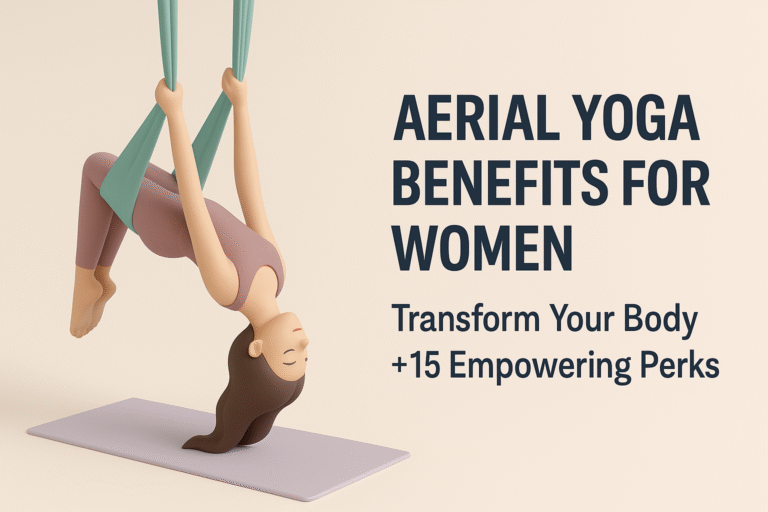
1. Introduction: Why Aerial Yoga for Women?
In today’s fast-paced world, women juggle multiple roles—career, family, health, emotions. For many, traditional workouts feel monotonous or demanding on joints. That’s where aerial yoga benefits for women shine. It’s playful, strong, and deeply therapeutic. By combining yoga, acrobatics, and suspension, aerial yoga offers a fresh way to tune your body and mind.
Unlike floor yoga, aerial supports you. You feel lighter, safer, and more willing to explore. Whether you’re chasing strength, flexibility, or inner peace, aerial yoga helps women unlock their full potential.
2. What Is Aerial Yoga?
Aerial yoga (also called anti-gravity yoga or hammock yoga) involves using a soft fabric hammock or sling hung from the ceiling. You use this hammock to assist, support, or suspend your body as you perform yoga postures. Wikipedia+1
It merges traditional yoga, pilates, and aerial arts into one holistic practice. The hammock lets you float, invert, and stretch with less strain. Many aerial classes welcome beginners—no prior experience needed. Healthline+1
3. The Science Behind Aerial Yoga
Aerial yoga introduces traction and decompression to your spine, promoting joint health and flexibility. Healthline+2Nike.com+2
The hammock also allows deeper stretching under support, so muscles and fascia can release gradually rather than forcefully. BetterMe+1
Inversions (where your head drops below your heart) help with circulation, lymphatic drainage, and brain oxygenation. Nike.com+2BetterMe+2
Besides, gentle motion and flow help reduce cortisol levels and activate your parasympathetic (rest) mode, making aerial yoga a potent stress-reliever. Healthline+1
4. 15 Benefits of Aerial Yoga for Women
Below are key benefits that make aerial yoga an ideal practice for women:
5. Benefit 1: Core Strength & Toned Midsection
Holding stabilization in the hammock forces your core muscles—abs, obliques, lower back—to engage continuously.
6. Benefit 2: Spinal Decompression & Back Health
Suspension helps gently stretch and decompress the vertebrae, easing pressure on discs and reducing lower back strain.
7. Benefit 3: Enhanced Flexibility & Range of Motion
Because the hammock supports weight, you can safely move deeper into stretches, reaching new ranges without overstrain.
8. Benefit 4: Better Balance & Stability
Working with a dynamic sling enhances proprioception, making your body more aware and balanced in motion.
9. Benefit 5: Stress Relief & Mind Calming
Swinging gently and focusing on breath invites relaxation, quieting the mental chatter and grounding the nervous system.
10. Benefit 6: Improved Circulation & Detox
Inversions and movements boost venous return and lymph flow, aiding detoxification and improving skin vitality.
11. Benefit 7: Hormonal Support & Gland Activation
Certain suspensions target the thyroid, adrenal, and endocrine system, helping women balance hormones naturally.
12. Benefit 8: Weight Management & Metabolic Boost
Aerial practice includes strength + cardio elements, which help burn calories and rev up metabolism.
13. Benefit 9: Joint-Friendly Workout
Less impact on knees, ankles, and hips because your body is partially supported by the hammock.
14. Benefit 10: Increased Confidence & Playfulness
Overcoming fears and mastering aerial moves builds inner strength and a bold mindset.
15. Benefit 11: Posture Correction
Suspension helps realign the body and counteract slouching or cervical stress from daily screen use.
16. Benefit 12: Better Sleep & Recovery
Stress reduction and improved circulation lead to deeper, more restful sleep cycles.
17. Benefit 13: Community & Social Empowerment
Aerial classes often foster supportive communities where women uplift and motivate one another.
18. Benefit 14: Inversion Access Safely
You can access inversion benefits (like headstands) with hammock support, reducing neck strain.
19. Benefit 15: Mind‑Body Connection Deepened
Trusting the hammock and tuning into movements brings heightened body awareness and inner calm.
20. Who Should Practice & Safety Tips
Aerial yoga is great for most adults, but there are cautions:
Avoid if you’re pregnant (unless experienced and under guidance)
Consult your doctor if you have glaucoma, high BP, or spinal injuries
Start with low-level classes
Wear fitted clothing (no loose fabrics that tangle)
Remove jewelry
Ask for modifications if needed
21. How to Start: Tips for Beginners
Try a beginner-friendly aerial flow
Practice trust and transitions slowly
Warm up joints before using hammock
Use padding under hammock if needed
Communicate with your instructor about discomfort
Don’t rush—consistency > complexity
22. Sample Aerial Yoga Routine for Women
| Movement | Purpose |
|---|---|
| Supine cocoon drift | Gentle spine release |
| Hammock-supported lunge | Hip openers |
| Inverted knee tucks | Core + circulation |
| Hammock-assisted forward fold | Hamstring release |
| Seated/standing aerial flows | Balance + strength |
| Cocoon rest pose | Deep relaxation |
Practice 45–60 minutes, with emphasis on breathing and slow transitions.
23. FAQs on Aerial Yoga for Women
Q1. Can aerial yoga help with PCOS and hormonal balance?
Yes, by enhancing circulation, reducing stress, and activating endocrine glands, aerial yoga can support hormonal regulation.
Q2. How many times a week should I practice?
Start with 1–2 sessions per week, then gradually ramp up to 3 depending on your body’s response.
Q3. Will aerial yoga bulk me up?
No, it tones and strengthens without excessive bulk—it’s about lean strength and agility.
Q4. Is there age limit?
Not really. Women from their 20s to 60s can benefit, with modifications for flexibility and strength differences.
Q5. Does it require upper-body strength?
Some strength helps, but many moves are assisted and scalable. Beginners build strength gradually.
Q6. Is it safe for back issues?
Yes, under guidance. The hammock can help decompress the spine, but always consult your doctor/instructor first.
24. Conclusion: Fly Strong, Live Light
Aerial yoga isn’t just a fitness trend—it’s a transformative practice especially suited for women. From deeper flexibility and spine health to hormonal support and emotional balance, its benefits soar. Step into the hammock, trust your body, and let gravity become your ally.
Instagram:@thepinklotusacademia
Facebook: @thepinklotusacademia
Enquire Now: Click Here
Learn more: The Pink Lotus Academia
Youtube: The Pink Lotus Academia
Other Blogs: Click Here
Buy recommended Yoga Apparels: https://amzn.to/4dS9J4H